Family Strength and Income in Households With Children
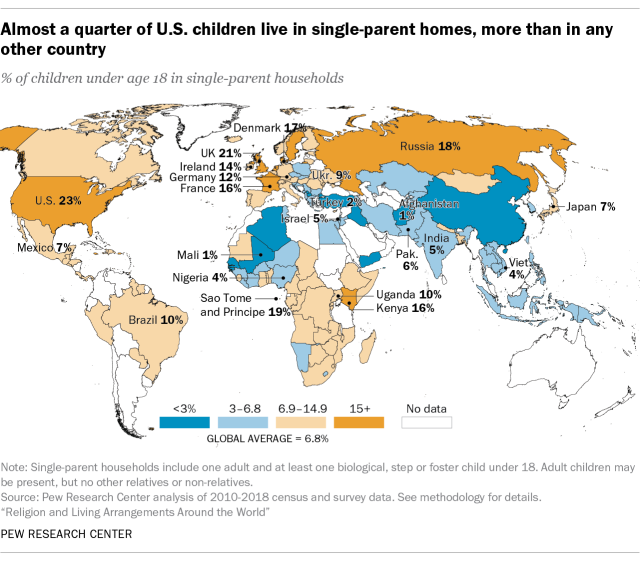
For decades, the share of U.S. children living with a single parent has been rising, accompanied by a pass up in wedlock rates and a rise in births outside of spousal relationship. A new Pew Research Center study of 130 countries and territories shows that the U.S. has the globe's highest rate of children living in single-parent households.
Nigh a quarter of U.Southward. children under the age of xviii alive with i parent and no other adults (23%), more than three times the share of children around the world who do and then (7%). The report, which analyzed how people's living arrangements differ past faith, also found that U.Due south. children from Christian and religiously unaffiliated families are virtually equally likely to live in this type of organization.
In comparing, iii% of children in China, iv% of children in Nigeria and 5% of children in India live in single-parent households. In neighboring Canada, the share is xv%.
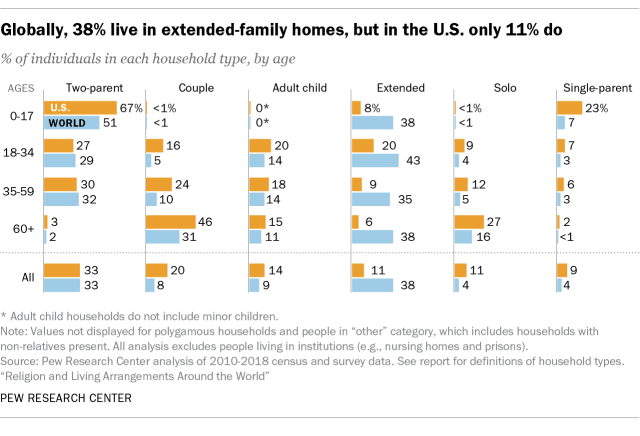
While U.S. children are more likely than children elsewhere to live in single-parent households, they're much less likely to alive in extended families. In the U.S., 8% of children live with relatives such every bit aunts and grandparents, compared with 38% of children globally.
Researchers accept different ways of categorizing unmarried-parent households. In this study, single-parent households accept a sole adult living with at least i biological, step or foster kid under age xviii. Some other organizations, including the U.South Census Bureau, also include households that have grandparents, other relatives or cohabiting partners present.
Economical well-being a factor in household size
Around the world, living in extended families is linked with lower levels of economical development: Financial resources stretch further and domestic chores such as childcare are more easily achieved when shared amid several adults living together.
The U.S., similar other economically advanced countries, particularly in Europe and northern Asia, has relatively small households overall. The average person in the U.Due south. lives in a abode of three.four people – which is less than the global average of 4.9, but slightly college than the European average of 3.ane. In the U.Due south., Christians (3.4), the unaffiliated (3.2) and Jews (3.0) live with roughly the same number of household members.
However, household sizes vary by age – the boilerplate U.S. child under 18 lives in a household of 4.6 members, while the average adult age threescore or older but lives with one other person.
In early on adulthood, Americans go on to live with their parents at relatively loftier rates. Developed kid households business relationship for xx% of Americans between the ages of 18 and 34. (Adult child households are divers as at to the lowest degree i parent living with one son or daughter 18 or older and no minor children or other family unit members.) Immature adults in the U.S. are like to their Canadian counterparts in this regard, and Due north America has a college share of young adults who live in this arrangement than any other region.
U.S. differs in living arrangements for older adults
Americans also differ from others effectually in the world in their living arrangements afterwards age lx. Older adults in the U.S. are more likely than those effectually the globe to age alone: More than a quarter of Americans ages 60 and older live lonely (27%), compared with a global boilerplate of 16%. There are just fourteen countries with higher shares of older adults living alone, and all are in Europe. They include Lithuania (41%), Kingdom of denmark (39%) and Hungary (37%).
The most common arrangement for older U.S. adults, however, is to alive as a couple without any other children or relatives. Almost half of U.Due south. adults ages 60 and older live in such households (46%), compared with a global average of 31%. Conversely, older Americans are much less probable to alive with a wider circle of relatives. Just half dozen% of older U.S. adults alive in extended-family unit households, compared with 38% of adults ages 60 and older globally.
Living in smaller households subsequently historic period 60 is oft tied to national rates of economic prosperity and life expectancy. Older adults are more likely to alive alone or as couples in countries where an boilerplate person tin await to live more than 70 years. In countries where lives are shorter, adults sixty and older tend to live with other family unit members instead. Life expectancy is often linked to other markers of prosperity within a land, so older adults who tin await to alive into their 80s also tend to live in countries where living lonely is more affordable.
And in countries where governments provide fewer retirement benefits or other safety nets, families oftentimes face up greater responsibility to support crumbling relatives. Cultural norms also play a role, and, in many parts of the world, information technology is expected that adult children will care for their aging parents.
Despite these many differences, U.South. household patterns are also similar to those in other countries in some ways, and a few of these commonalities are tied to gender.
Women ages 35 to 59 in the U.S., for case, are more likely than men in the same age grouping to live as single parents (9% vs. 2%), a pattern mirrored in every region and religious group around the world.
And women, on average, are younger than their husbands or male cohabiting partners in every state analyzed. That age gap is 2.ii years in the U.S. and in the rest of the world ranges from 2 years in the Czech Commonwealth to 14.five years in Gambia. Within the U.S., Jewish partners are closest in age, with only ane twelvemonth between them, while Christians and the unaffiliated take an equal gap (2.two years).
Coupled with women's longer life expectancy, this tendency helps explain some of the differences in how older men and women in the U.S. live.
More than one-half of U.Southward. men ages 60 and older (55%) live with a partner and no one else, while roughly four-in-10 women (39%) practise. And almost a third of women ages lx and older alive lonely (32%), while this is true of ane-in-five men in the aforementioned historic period group (xx%).
Notation: Come across total methodology.

Stephanie Kramer is a senior researcher focusing on religion at Pew Research Center.
Source: https://www.pewresearch.org/fact-tank/2019/12/12/u-s-children-more-likely-than-children-in-other-countries-to-live-with-just-one-parent/
0 Response to "Family Strength and Income in Households With Children"
Post a Comment